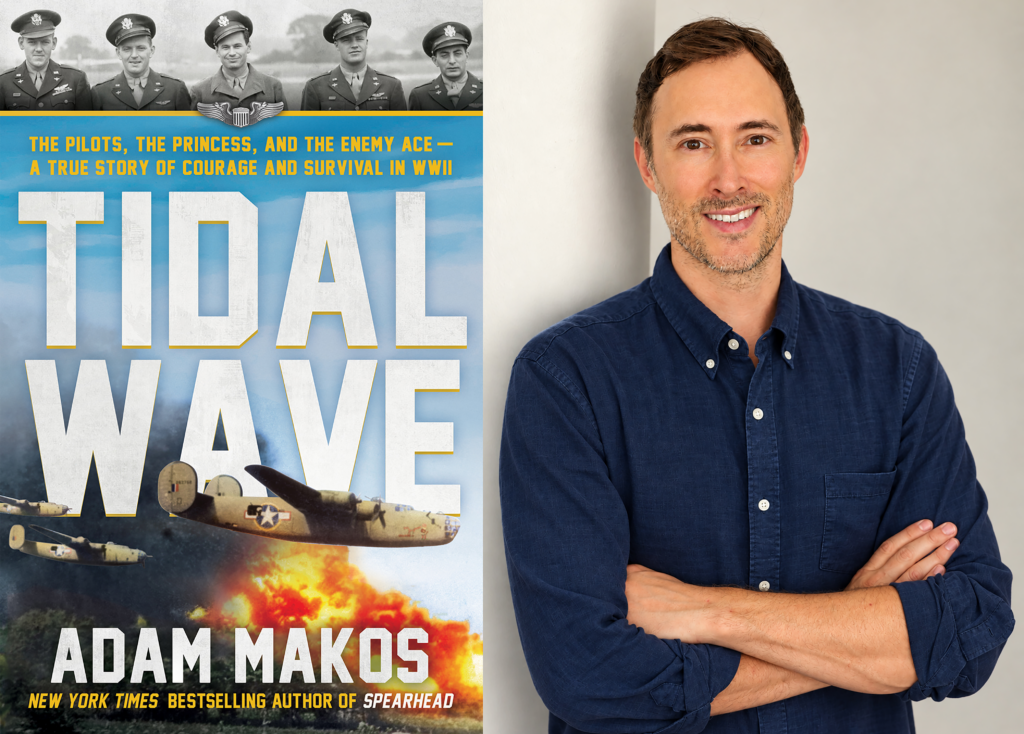
The air raid on the oil refineries at Ploesti, Romania, is one of the most important and costly air raids by the United States Army Air Forces during World War II. This largely overlooked and forgotten raid is highlighted in a vivid manner in local author Adam Makos’ new book, Tidal Wave.
Makos is the author of several previous World War II-themed books, including Higher Call, Voices of the Pacific, and Spearhead.
Webb Weekly asked Adam about his latest book, and he shared his thoughts with our readers and us.
What prompted you to do this story, and was there something in particular that attracted you to it?
“I was actually steered to the story most unexpectedly. In 2018, I was visiting with Mr. Fred Smith, the founder and CEO of FedEx, who was producing a movie about my book Devotion. But that day in Memphis he didn’t want to talk about the film project. Instead, he told me the story behind Tidal Wave — that during the most dramatic air raid of World War II, one bomber was shot down and crash-landed on the estate of a Romanian princess. She was their enemy by nationality, but what she did next would form a bond between her and the American crew that would last the rest of their lives.
My brother Bryan, who essentially operates as a co-author on these projects, started digging and found that of the 1,700 men who flew the raid, there appeared to be only one survivor, and he was still alive: Ernie Poulson. And by chance, Ernie was the copilot on the bomber that landed on the princess’s estate.
He was 97. What were the odds that he would be the last known survivor? This story feels written in the stars.”
Before you worked on this book, had you ever heard of the raid on Ploesti?
“I had heard of the famous raid. It’s a legend in military history. It reads like a movie script: in the summer of 1943, every B-24 bomber on that side of the Atlantic was gathered in one place, Benghazi, Libya, to launch a secret mission that could shorten the war dramatically and cripple Hitler’s war machine: the destruction of the oil refineries that supplied 30% of his oil.
The Ploesti raid, Operation Tidal Wave, was the most heroic and highly decorated American air mission in history.
Five Medals of Honor were awarded from this mission, three of them posthumously, which gives you an inkling of the danger the raid entailed. There were 56 Distinguished Service Crosses, our nation’s second-highest award for valor. And every man who flew it was awarded the Distinguished Flying Cross. This was the single greatest American mission in history, the most bloody, and the most decorated. In the medal department, it even rivals D-Day, and that was an entire invasion of a continent.”
What type of research and sources did you have to use in preparation of this book?
“The number one source was Ernie himself. At first, he was reluctant to tell his story. He had lost his wife. He had lived a full life. Why bother going back into the past? He had already lived an absolutely astounding wartime journey. But we told him, this will be about all the guys.
Through your story and the story of your crew, we can tell the story of all the men who flew in, some of whom died in that epic raid, and the untold aftermath: what happened to the men who were shot down? That’s what Ernie’s story included. Not only was his rookie crew on their second mission when they flew in the Ploesti raid, the worst second mission a crew could ask for, but they didn’t make it home. They were shot down, and he would go on to experience the strangest POW experience of World War II, when he and 110 other men were imprisoned in an Alpine lodge high in the Transylvanian Alps. What began as something like “Hogan’s Heroes,” in the end carried all the seriousness and life-and-death stakes of The Great Escape.
That’s what got Ernie to open his door to us: this book would be a tribute to every man who climbed into a B-24 on August 1, 1943, and steered north for Romania. From there, we met with the families of each of Ernie’s crew, and it turned out the men had left behind an incredible document written in 1944. After the survivors made it to England, while they were waiting to be debriefed, each man wrote down his memories of the operation. Every survivor recounted his experience on the great raid, from the navigator to the tail gunner. This was on their own. It wasn’t for a medal inquiry or an after-action report. The pilot of the bomber typed it all up, and that came to us from his daughter. With that as a starting point, the book was already in an amazing place.”
During your research, was there something that surprised you about the story?
“Going into this book, I just thought of Romania as an Axis partner. What I discovered, and what was surprising, was that the Romanians liked the Americans. When Ernie made a run for it from his crashed bomber, he was eventually captured and imprisoned in a cistern below ground.
Then the trapdoor opened, and he heard those fateful words spoken in English: “Hello, boys.”
That was his first meeting with Princess Catherine Caradja. She had already rescued Ernie’s navigator, extracting him from the damaged aircraft where he was pinned and soaked in gasoline. She owned 1,000 acres, including the land they crashed on. And Ernie was surprised to discover that she would have been happy not to have another drop of oil reach Hitler. She didn’t blame them for coming there and bombing the Romanian refineries.
The Romanians liked Americans. They had been our ally in World War I. They had come to know Americans in the interwar years from our engineers who ran the refineries before the war. They taught Romanian kids to play baseball. The Romanian people wanted to watch movies like “Gone with the Wind, which was banned by the dictatorship.
And how they came to be on the side of Hitler was a stroke of terrible luck. The Russians had stolen some of their ancestral lands, and Romania was too powerless to take them back. Hitler saw an opportunity. He pledged to help them if they would form an alliance and sell him the oil he needed. What he did next surprised his “ally.” He marched in with his troops and took over their refineries and paid them in airplanes and tanks, not money. He helped them liberate their land from the Russians, and then he urged Romania to come with him into his war on the Eastern Front. Suddenly the whole nation was in a tough spot: they had reclaimed their land from Stalin, but what would happen if Hitler lost the war? Stalin would be coming at them with a vengeance. That’s how Romania plunged itself into World War II.”
What should the reader take away in meaning from this book?
“I hope readers will come to understand that Ernie and his comrades are important Americans who earned their place in our memory. They flew arguably the most spectacular mission in military history, and many of them paid for it with their lives: 45 bombers were shot down by enemy fire, almost a quarter of those that set out. It was the highest casualty rate in any single air mission in our history, and the most decorated mission. The stories of heroism that you’ll find in Tidal Wave will leave you speechless. And the ultimate legacy of those men and their sacrifice would show up at the end of the war, during the Battle of the Bulge, when Hitler’s tanks ran out of gas in the Ardennes Forest, and young German fighter pilots were being sent into battle with 12 hours of flight time, because Germany was left without gasoline.”
Tidal Wave was ultimately a victory. It just took a year to show itself. “
How does this book compare with your previous books?
“This book shares the common theme of enemies who become friends: humanity in wartime.
But this book takes it to a whole new level. Not only is Princess Caradja a Romanian princess who helped our POWs survive captivity there, but there was King Michael, the 21-year-old king of Romania, who sat in Ernie’s crashed bomber and made a vow to help the American crew. And help them he did. Eventually, he would take on the dictatorship and the alliance with Hitler and pull his nation out of World War II. And then there is the Romanian fighter ace. We follow a prince dueling Soviet fighters on the Eastern Front, but he too loved Americans, and when it came to fighting them, he was searching for a way out. One day he would find himself on our side, fighting against the Germans he had once flown with. The cast of characters in this book goes beyond a simple friendship between foes. Each of these historical figures could have a movie or a miniseries made about them, and here it’s all wrapped up in one book.”
What future book projects are you looking at?
“I’m going to continue writing books about World War II because there’s something enthralling about the era: the clear-cut good versus evil, and the fact that we were all united as one country fighting for our survival and the survival of the world. World War II was probably the last time that Americans fully agreed about something and showed the power of our unity.”
I first knew about the raid on Ploesti as a nine-year-old reading an American Heritage Book called The Air War. Adam has written a powerful and compelling work that humanizes and vividly brings to life that raid and its aftermath. I would highly recommend it.
Adam will have a book signing at the Otto Bookstore on Sunday, November 1, from 1 to 4 p.m. Be sure to contact Otto’s if you wish to pre-order the book for Adam to sign.