Well, you weren’t wrong.
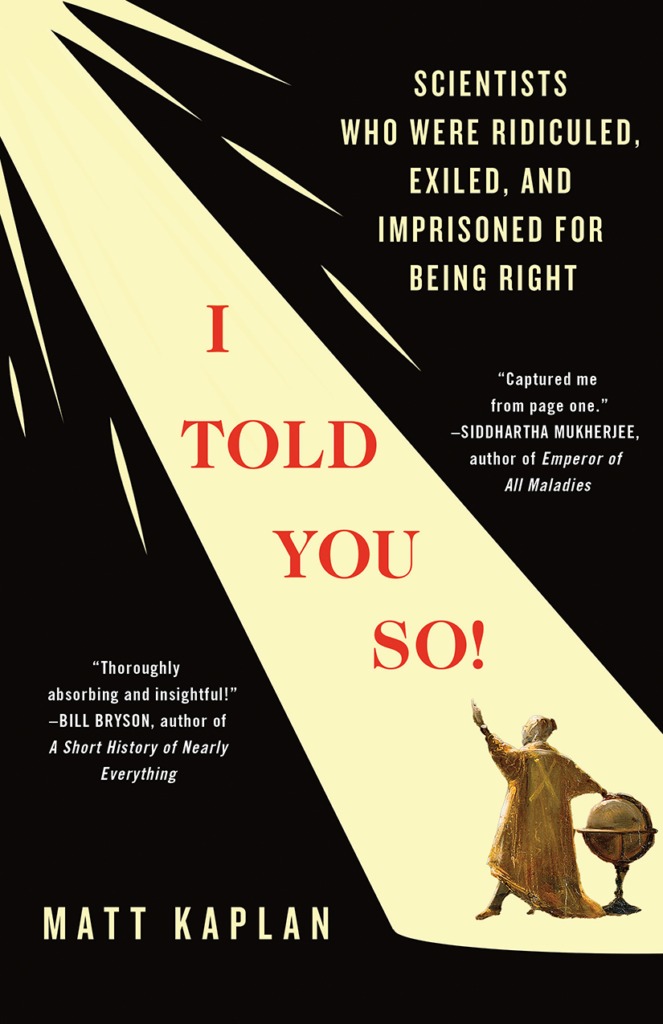
But you weren’t exactly right, either. There’s a middle ground between solved and unsolved, you were there, and everybody let you know about it. So, it’s back to the drawing board for you until, as in the new book “I Told You So!” by Matt Kaplan, you’re in a position to say nyah, nyah, nyah all day long.
As a science journalist who writes for several esteemed publications, Matt Kaplan has seen science careers rise, crash, and burn. Many times, he says, that wasn’t the fault of the scientist, but with their peers.
The very nature of the job of scientist is to question, explore, experiment, then put rigorously tested results forward for others to examine. Despite that this is how science works, doing so, he says, can result in anger from other scientists who hold grudges or who contrarily pooh-pooh any possible discoveries.
“Bias,” he says, “is everywhere in science.”
But the thing is, many times, in the end, the first scientist has been right. One hundred percent, unequivocally, no question correct. This goes for guys like Galileo and Darwin. It’s been true of Nobel laureates. And it’s meant life or death.
During the Renaissance, Austrian Empress Maria Theresa established hospitals to better the lives of her subjects but there was one thing that dogged the physicians there: a very high percentage of new mothers died of “childbed fever” and they died quick – often along with their newborns.
Hungarian Ignaz Semmelweis recognized the problem and began to study it, paying close attention to when and where it occurred. Wealthy women rarely died of childbed fever, he noted. Street women didn’t much, either. Poor women who gave birth in a common ward, commonly died, though, and often gruesomely.
Elsewhere, Louis Pasteur took up the issue, as did Joseph Lister but politics made them reticent to share their findings. Yet, despite ridicule and rejection, Semmelweis kept studying.
He sensed that the solution was probably (literally) close at hand…
According to those in the know, using soap and water is the most effective way to slow the spread of germs. With that in mind, it’s hard to believe that such advice is relatively new, and “I Told You So!” explains how we learned it.
Research, as author Matt Kaplan shows here, is not for the faint of heart – and that, he says, doesn’t do any of us any good since denial and egos can slow or stymie the cure for a disease or the solution to a problem. In this book, he uses his experience in various fields to show how the mind of a scientist works and what drives someone to dismiss evidence that’s right in front of them. With humor, personal stories, and history, he then explains to readers how we can stop detrimental progress-squashing, but it comes at a cost.
If you’re science-minded, hoping for a cure, or interested in medical history, this book is fun and informative. You might think “I Told You So!” is a great read, and you won’t be wrong.
“I Told You So! Scientists Who Were Ridiculed, Exiled, and Imprisoned for Being Right” by Matt Kaplan
c.2026, St. Martin’s Press
$30.00
288 pages