Now, before you grab a pick and shovel and head out back of my place to start digging up some of those gold nuggets, understand that the “gold” I’m talking about here is the gold color on birds and not gold nuggets.
I’m actually referring to the American Goldfinch and the Baltimore Oriole, both of which display that yellow-gold color that makes them stand out.
Of the two birds, we have had much more success attracting the Goldfinch, but the Baltimore Oriole has been more of a challenge to bring into the backyard.
Each spring, my wife and our daughter-in-law, Angie, are anxious to report who gets the first sighting out back of the house; Angie always wins.
The Goldfinch is smaller than the Baltimore Oriole. Breeding males are bright yellow with a black forehead, black tail, and black on the edge of the wings and rump. Some white bars show up on the wing.
Females and nonbreeding males will be duller in color and lack the black on the forehead.
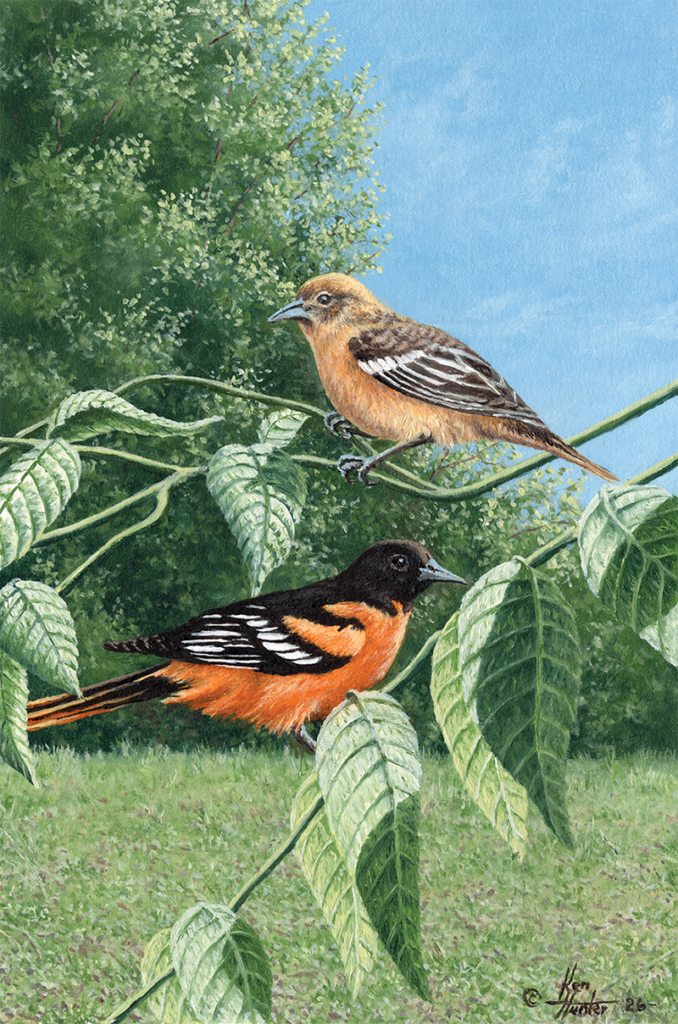
The male Baltimore Oriole has a black hood and neck and black wings with some white patches. A bright orangey yellow appears on the belly with a bar on the wing by the neck.
The female oriole is much less colorful, with an olive to greenish-gray that is vaguely streaked and washed with light yellow.
This year my wife and I have had much more success attracting the Baltimore Orioles, and I suspect it’s because of what we used to attract them. My daughter-in-law apparently felt bad and purchased a special feeder for my wife’s birthday to attract the Orioles.
You slice an orange down the middle and attach it to the peg on either side of the feeder. Just below where the oranges are attached is a small clear plastic bowl, and that is filled with grape jelly. The orioles were on that feeder almost every day, and I’m not sure which of the two items in the feeder were the most sought after. I will say that it seemed like I was filling the jelly bowl more often. I don’t know much about an Oriole’s behavior, but I haven’t seen any activity even around the feeder over the past couple of weeks.
Believe me, I’m not like some people who are dedicated bird watchers and have much more success at attracting a variety of birds. I do enjoy seeing them and photographing them.
As a wildlife artist, one of my favorite subjects is the various birds that show up at our feeders or in and around the yard.
The Baltimore Orioles out back in our walnut tree caught my attention this spring, and I found myself doing a painting of a male and female.
A couple of years ago, the goldfinches perched in the goldenrods out back led to a painting I appropriately titled “Gold on Gold”.
Of course, there are a lot of other birds that show up, and I enjoy seeing them as well. Cardinals, Blue Jays, Robins, Sparrows, Red-breasted Grosbeaks, Doves, Cedar Waxwings, and Eastern Bluebirds, just to name a few. Identifying the more common birds usually isn’t a problem, but I find the National Audubon Society’s Field Guide to North American Birds is a great help, especially when I want additional information.