One of my favorite types of fishing is hitting the lakes for a variety of panfish, especially crappies. I like crappie fishing for several reasons, and one of the main reasons is that when you find feeding fish, the action can be constant and last for extended periods. Let’s be honest, fishing is a whole lot more fun if you are not just fishing, but you are also catching, and a good day of crappie fishing can lead to a whole lot of catching. Another good reason to go after crappies is that they are wonderful table fare when properly prepared. A dozen crappie fillets rolled in eggs, cracker crumbs, then fried in butter, is a great way to cap off a good day out on the lake.
Crappies move into shallower water in and around wood cover, weedy edges, and rocky shorelines in the spring to spawn, but by now, they are pretty much done with the spawn, and they move to deeper water. They are still very catchable, but to be honest, a boat will certainly increase your potential for success. Sure, fishing deep water off a rocky shoreline can produce some fish, but being able to roam all over a lake can lead to much more action. It’s probably a good idea to hit lakes with some reasonably deep water, maybe in the 20-30 foot range. Once we hit this time of year, we head for the open water and begin searching depths of at least 10 or 12 feet and deeper. It’s also a good idea to have sonar so you can see at what depths the fish are holding. This time of year, it’s no secret that crappies will move out into the open water, and it’s very common to spot fish suspended up and down the entire range. This past week, my brother and I fished a lake, and the sonar showed fish scattered up and down the entire range, as deep as 35 feet.
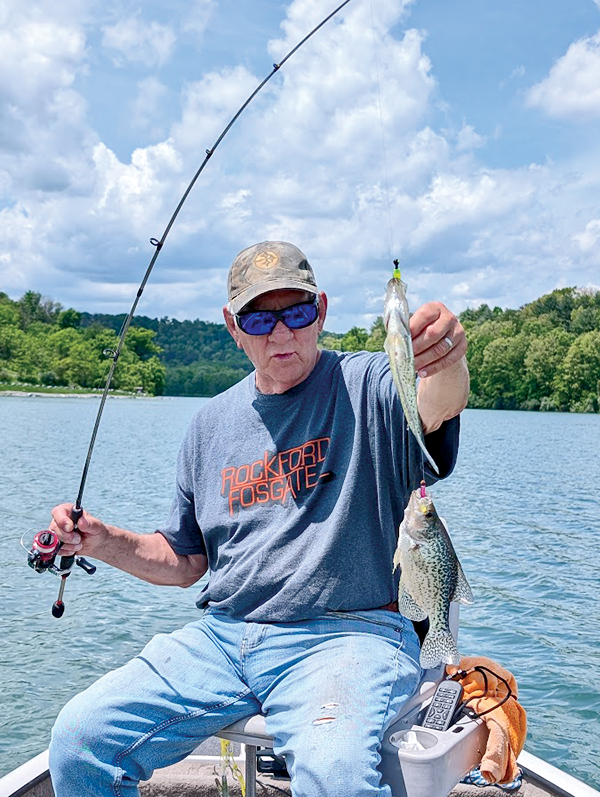
Unless you are pretty certain where some crappies are holding, it’s probably best to begin by slow trolling, keeping your eyes on the sonar and waiting until you begin to get some strikes. Trolling can be done in a couple of different ways, with the most common approach being to place your rod or rods in a rod holder or to simply hold the rod while the offering trails behind the boat. You can also employ both techniques by holding one rod and placing two in the rod holders. Using three rods at once is permissible. To be honest, I usually fish with one rod in the holder and one in my hand. I like to hold one rod because I can feel the strike and see the rod tip move. It’s important when you are trolling that you try to work your lures at different depths. When crappie fishing, you can’t fish too big a lure, so that weight may be insufficient; no problem-just add a split shot or two a foot or so above your offering to get the lure down deeper. We often fish with two jigs tied about two feet apart, so we already get deeper, and make our offering at two different depths at the same time. By the way, it does happen that you get two fish at the same time on that double lure presentation, as you can see in the photo with my brother. I also ended up with a double.
If your trolling results in some steady strikes, try to hold that location and work it with some casting and slow retrieves, but keep that lure at the depth where the strikes occurred. A flexible, ultralight open-faced spinning outfit with around four-pound-test line and eighth-ounce jigs is a good presentation.