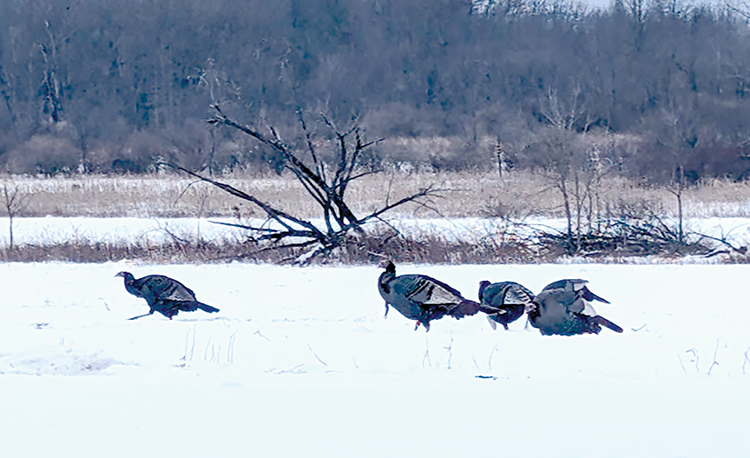
Like many hunters or people just interested in seeing wildlife, I’m always on the lookout as I travel from place to place. This past weekend, my wife and I had to make daily trips to Bloomsburg to attend the Early Bird Show at the fairgrounds. We traveled the backcountry roads each morning and evening; my wife usually drove, so I could gaze around for wildlife. On the first day, we were driving along some brushy, low flat bottom land with some open fields when I spotted a number of turkeys only ten yards from the edge of the road. There were a couple of really nice gobblers, but I couldn’t be sure of the other turkeys. A couple of days later, and ten miles before the other sighting of turkeys, we were traveling along similar cover when we both spotted about 40-50 turkeys again, only 20-30 yards from the road edge. There were a good number of gobblers, some with pretty good beards, and some hens as well. Apparently, the turkeys were very focused on finding food since we stopped at the edge of the road and I photographed them scratching into the deep snow, but they made no attempt to move or flee.
What was interesting about these turkey sightings was that they were both on low-lying flat ground, with some open fields, moving water, and spring seeps. Needless to say, this winter has been like some past winters, with plenty of snow, making it more difficult for wild turkeys to find food. During the winter, turkeys rely on seeds, nuts, and fruits left over from the fall period, but they also rely on green plants, crustaceans, and insect larvae that can be found in and around spring seeps and where groundwater runs below hillsides in flats below and in open fields. I suspect that during this period of heavy snow cover, we will spot more turkeys in these areas seeking food than on the wooded mountain sides. As the evening hours approach, the turkeys will head up into the wooded areas, especially into the large hemlocks, to roost for the night.
Once the cold, heavier snow takes hold, as we are experiencing now, turkeys may begin to concentrate into relatively large flocks, like the flock my wife and I saw last week. It’s not something we have experienced in recent years, but heavy snowfall can certainly be a problem for turkeys when it comes to finding food and getting to it. A turkey’s legs aren’t all that long, so trying to scrape through a couple of feet of snow would prevent eating.
Pennsylvania’s turkey population has been growing, but our winters have not been particularly severe, which may have contributed to their increase. No doubt, cutting down forests has been a positive factor, as have trap-and-transfer programs that move turkeys to new and productive habitats. Well, here’s hoping this winter isn’t too hard on our turkey population. In the meantime, I’ll be watching that winter habitat for some of those big flocks.