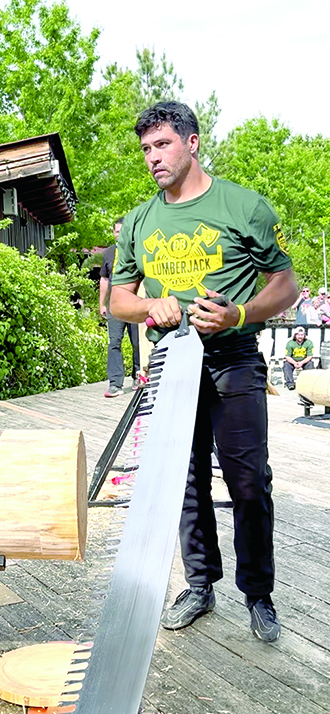
What started as a weekend diversion has become a serious athletic pursuit for local Dominic Ruckle, a Pennsylvania lumberjack sports competitor who has climbed quickly into the upper ranks of Stihl Timbersports. In just five years, Ruckle earned an invitation to the U.S. Championship pro qualifier, an invite-only event based on an athlete’s competitive resume. For a sport where it often takes eight years or more to reach that level, Ruckle is moving up unusually fast.
In June, Ruckle finished seventh in his qualifying pool of 12 athletes, with only the top two advancing to the U.S. Championship in Milwaukee, Wisconsin. While he did not make the final field this time, simply getting to the qualifier marked a major step forward. The winner of the U.S. Championship advances to compete overseas and represent the United States on the world stage. For Ruckle, now 35, that remains the long-term goal.
“My goal is to make the finals before my career is over,” Ruckle said. “I can probably compete on the pro level for another 10 years before I start slowing down.”
His ambition is more than just winning trophies. Ruckle sees the sport as a test of strength, timing, mental focus, and discipline. Athletes race the clock and each other through traditional logging skills, using razor-sharp axes, crosscut saws, and high-powered chainsaws. At the highest level, small mistakes can cost seconds and determine whether a competitor moves on or goes home.
Ruckle first found lumberjack competition through a friend and co-worker, Sean Frantz, who was involved with the Pennsylvania Professional Lumberjack Organization. After moving back to Pennsylvania from Colorado, Ruckle watched one of Frantz’s events and immediately wanted to try it. With a background in wrestling and rodeo bull riding, he was already drawn to physically demanding challenges. Lumberjack sports offered another way to discover what he could do. “I am an athlete that is always looking to find hidden potential in myself,” Ruckle said. “After watching it, I had to try it. I haven’t stopped since. It’s addicting, it’s fun, and it’s athletic.”
His progress came quickly. What began as a fun weekend competition to make a little side money and stay in shape became a path toward the sport’s premier stage. Ruckle has competed against athletes from around the world, including Italy, Australia, Belgium, Canada, and the Czech Republic. In 2025, he earned three first-place finishes in the hot saw event, the discipline that has come most naturally to him.
Hot saw is one of the sport’s most explosive events. Competitors use custom-built, high-powered chainsaws to make rapid cuts through a log. Ruckle’s hot saw is built with Honda parts and has a 280cc engine. Even with that power, he often gives up placement to competitors using 330cc to 400cc motors. Some pro-level saws produce more than 60 horsepower and weigh roughly 55 pounds, making the event a demanding mix of power, balance, and control.
Stihl Timbersports, known as “The Original Extreme Sport,” features top lumberjack sports athletes competing in six disciplines: underhand chop, stock saw, standing block chop, single buck, springboard chop and hot saw. The series began in 1985 at regional U.S. logging competitions and has grown into an international championship circuit, with national events in dozens of countries and world championships for individual competitors and teams.
Beyond Stihl Timbersports, regional competitions continue to keep the lumberjack tradition alive. In Pennsylvania, the Pennsylvania Professional Lumberjack Organization helps organize events that celebrate the logging industry. Ruckle was named the organization’s 2022 Axeman of the Year, a recognition that reflected his commitment and rapid advancement in the sport.
Competitions are timed sprint races. Athletes chop blocks, saw through logs, throw axes, and maneuver timber through courses. The axe disciplines include underhand chop, standing block chop, and springboard chop. In the underhand chop, the athlete stands on the block and chops through it, simulating work that once happened in the woods. In the standing block chop, the log is mounted upright, and competitors attack it from both sides. Springboard chop requires athletes to climb a pole using two boards before chopping a block near the top, combining balance, rhythm, and strength.
The saw disciplines include one-man, two-man, and jack-and-jill crosscut events. There is also axe throwing, though it differs from recreational axe throwing at bars as the target is farther away, the axe is larger and heavier, and the handle is longer. In peavey log rolling, competitors use a peavey or cant hook to guide a log through a course as quickly as possible.
Equipment for timbersports competitions is specialized and expensive. Beginners often start by purchasing a racing axe, with even an entry-level model costing around $300 to $350. Safety gear is essential, including chainmail foot protection worn like a sock to guard against accidental axe glances. At higher levels, athletes may use $600 axes sharpened for specific wood species such as pine, aspen, or poplar. For major competitions, Ruckle said an athlete might bring 10 axes for testing and preparation. Crosscut saws can cost $3,000 or more after purchase and shipping, often from Australia or New Zealand, where many of the best racing axes and saws are made. Entry fees also increase as athletes move up. A small Saturday competition may cost about $40 to enter and offer a few hundred dollars in prize money. Larger three-day pro-level events can cost more than $200 to enter and may be held anywhere across the lower 48 states.
Ruckle has already competed throughout the East Coast, including events in Pennsylvania, Ohio, West Virginia, Virginia and New York. He hopes to expand that schedule to the West Coast and eventually to international contests in New Zealand or Australia, where timber sports have deep competitive traditions.
For Ruckle, the appeal is not only the competition. The sport has become a way to travel, meet people, train consistently and stay in shape. He describes timber sports as one of the best parts of his life, something that began as a hobby but grew into something far greater than expected. “I’m grateful to have found the sport,” Ruckle said. “I recommend to anyone who wants a little more out of life to get out there and try whatever it may be that you are interested in. It could turn into something much bigger.”
His competitive goals have evolved with his success. Early on, he wanted to beat the athletes who mentored him. After reaching that milestone, his focus shifted toward bigger events and stronger fields. Now he wants to measure himself against the best in the sport and continue improving while he has the strength, speed, and drive to do it. “My competitive goal is to be the best version of myself that I can be,” Ruckle said. “Now, the goals are broader. I want to travel to larger events and see where I stand against the best in the sport.”
If his first five years are any indication, Ruckle has positioned himself as one of the sport’s fast-rising competitors. He has moved from local contests to national-level qualifying, found success in hot saw, and built a reputation through steady competition and training. The next step is the hardest: breaking through from qualifier to finalist. But Ruckle’s path so far suggests he is not done climbing.
For more information about the Pennsylvania Professional Lumberjack Organization, visit pplo.org or find the organization on Facebook.