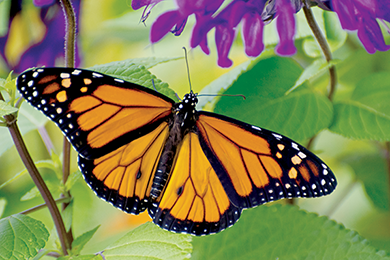
Since 1996, the population of monarch butterflies in the Eastern United States has declined by nearly 80%, and one of the biggest reasons is the loss of habitat. Monarchs need early successional vegetation, with milkweed and various flowering plants such as goldenrod that often can be found in fallow fields, highway edges, and agricultural field edges. Monarchs in the caterpillar stage feed exclusively on milkweed. During the summer months, monarchs can be observed flying across fields in search of bright flowering blooms as the adults feed on the nectar from a wide variety of flowers.
Monarch butterflies can be found in South America, Central America, and in North America east of the Rockies. Tens of millions will gather in central Mexico during the winter. The lifespan of a monarch butterfly ranges from two to six weeks for summer generations, while the migrating generation can live for six to nine months!
Year after year, their seasonal activity is the same. In the summer (June-July): Local breeding and feeding happen; butterflies are active in short cycles lasting a few weeks. Then, the fall migration (August-October) occurs, peaking heavily through September and October as millions fly south. In the winter months (November-December), butterflies rest and cluster in trees in Mexico to save energy, moving little unless the weather warms up. Finally, in the spring (February-March), the butterflies wake up, mate, and start flying north – and the process begins all over again.
So, what is it that we as humans can do to help slow – and hopefully reverse – the decline of the population of the monarch butterflies? The answer is actually fairly simple. Do what we can to improve their habitat.
Are milkweeds absolutely necessary for monarchs? The answer is a resounding “yes”, because newly hatched caterpillars eat only milkweed leaves, and without them, they will die. Thus, adult monarchs lay their eggs on milkweed plants. Milkweed sap contains toxic compounds that caterpillars and butterflies store in their bodies, making them poisonous and taste bad to predators.
In the adult, or butterfly stage, the monarchs drink nectar and thus gain energy from a wide variety of flowering plants, including sunflowers, coneflowers, zinnias, lantanas, ironweed, black-eyed susans, and goldenrod. A few additional flowering plants that butterflies love are coreopsis, blazing star, joe-pye weed, and native asters. For further information as to what native flowering plants are appropriate for our area, check with your local source of seeds for food plots or lawn seed. These pollinator wildflowers can add to the visual appeal of a property by planting a variety of spring, summer, and fall flowering plants in islands in a yard area, by adding them as a border around an existing garden, by lining the side of a driveway, or by dedicating a strip or edge of a larger field for their planting.
One of the best ways we can help the monarch butterflies throughout the state is to not mow all of our fields, but allow some to go fallow and thus permit goldenrod and milkweed to propagate and flourish. If it is just not feasible to abandon an entire field to allow milkweed and goldenrod to grow, consider some field edges to become fallow areas where these plants can grow and survive. These added “abandoned” fields or edges will add a much-needed food source as well as propagation areas for the magnificent butterflies. These fallow areas will provide additional habitat for numerous birds and mammals.
Additionally, consider adding milkweeds and various flowering pollinators to your property. You can easily create a monarch habitat in your fields, yard, garden, or even in potted containers on a sunny patio. Because monarch caterpillars eat only milkweed, planting common milkweed, swamp milkweed, or butterfly weed will provide a place for females to lay eggs and caterpillars to feed. Adult butterflies need energy for migration, so plant a variety of native nectar-producing flowers that bloom from spring through fall. Place your habitat in an area that gets full sun and is protected from harsh winds.
Avoid pesticides whenever possible. Never use chemical insecticides, pesticides, or systemic neonicotinoids, as they are toxic to both caterpillars and butterflies.
And finally, there exists today an organization, The Monarch Joint Venture, a nonprofit made up of federal and state agencies, non-governmental organizations, businesses, and academic program partners working together to conserve the monarch butterfly migration for future generations. For more information, contact them at: athttps://monarchjointventure.org/.